
Considering buying in Jersey City? Maybe renting in Manhattan has you tired of writing checks that could be building equity. Maybe residing in Hudson County already has you ready to move up. Maybe relocating for work brought you here, and you heard Jersey City offers a different value profile than Brooklyn.
This guide answers the question you're actually asking: what does it take to buy Jersey City homes for sale in 2026, and is it worth it?
The short version: Jersey City's median condo price hit $724,000 in June 2026, up 5.7% year over year. Single-family homes landed at $725,000 median, up 4%. Inventory is tight in some segments, looser in others. The market rewards prepared buyers and punishes those who show up without pre-approval or realistic expectations.
Let's walk through what you need to know.
Are You Actually Ready to Buy Jersey City Homes for Sale?
Before you start touring, run yourself through these checkpoints. They're not optional.
Credit score reality check. A 620 minimum gets conventional financing, but 740+ gets the best rates. Current mortgage rates significantly impact monthly payments, and the difference between a 700 and 760 score can mean tens of thousands over the life of the loan.
Down payment math. Jersey City's median condo at $724,000 requires a substantial down payment. Many buyers come in at various down payment levels and pay PMI until they hit sufficient equity. First-time buyers using FHA can go as low as 3.5% down, but mortgage insurance stays for the life of the loan.
Reserve requirements. Lenders want to see 2-6 months of mortgage payments in reserves after closing. On a $724,000 condo, your monthly payment (principal, interest, taxes, and HOA) can run $5,500 to $6,500. Reserves need to cover that.
Debt-to-income ceiling. Most lenders cap DTI at 43-45%. If you earn $200,000 household income, total monthly debt payments (including the new mortgage) shouldn't exceed roughly $7,500.
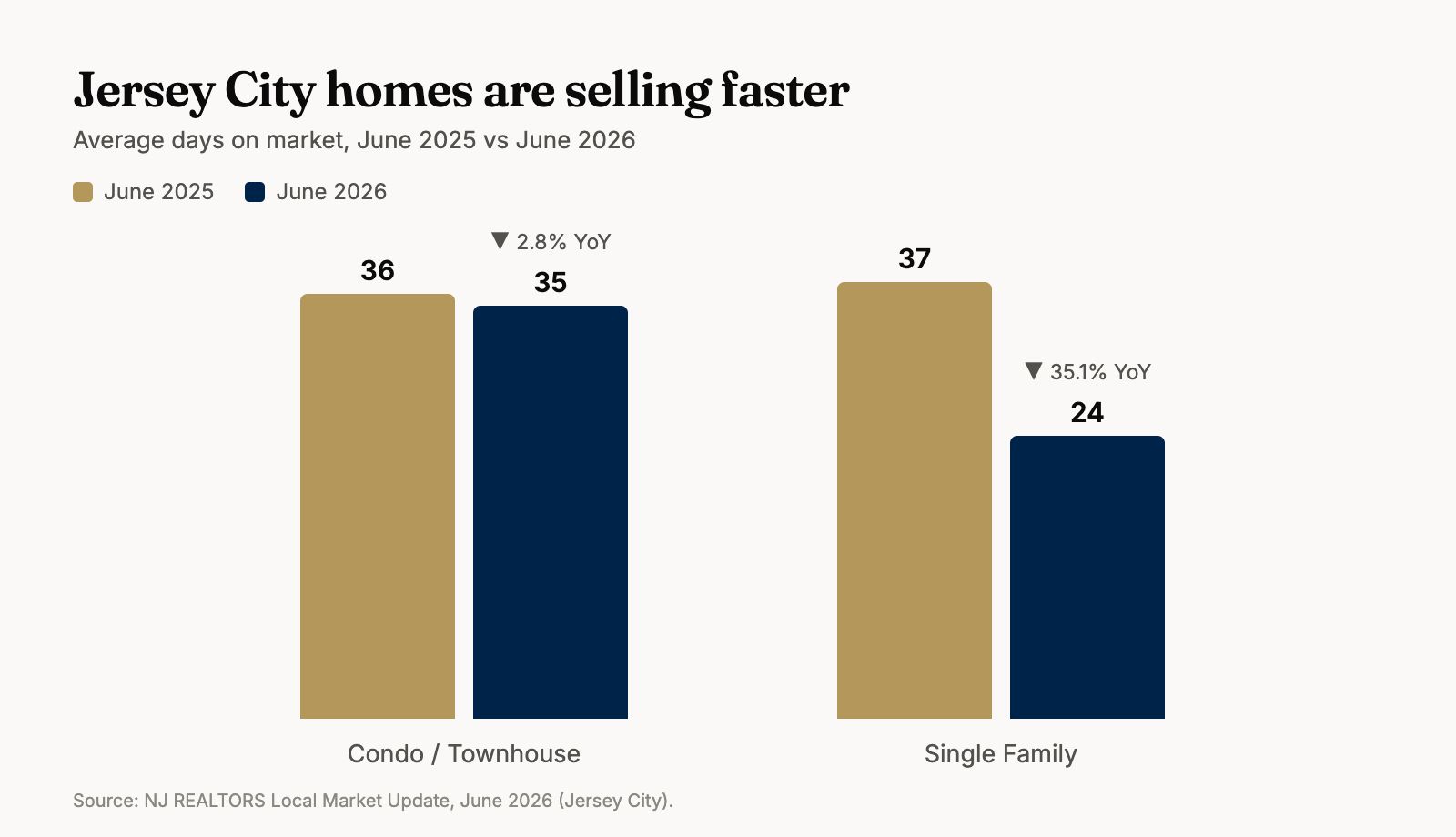
Pre-approval vs. pre-qualification. Pre-qualification is a conversation. Pre-approval is a commitment letter based on verified income, assets, and credit. In Jersey City's market, where condos sell in 35 days on average and single-family homes move in 24, you need the latter before you tour.
What Your Money Buys in Jersey City
Jersey City spans over 21 square miles with dramatically different price points depending on where you look. Here's what each tier actually gets you, based on current inventory patterns.
Entry-level tier: Studios and one-bedrooms in buildings without doormen, or co-ops with stricter approval processes and flip taxes. Greenville and parts of Bergen-Lafayette offer entry points here, though inventory is limited.
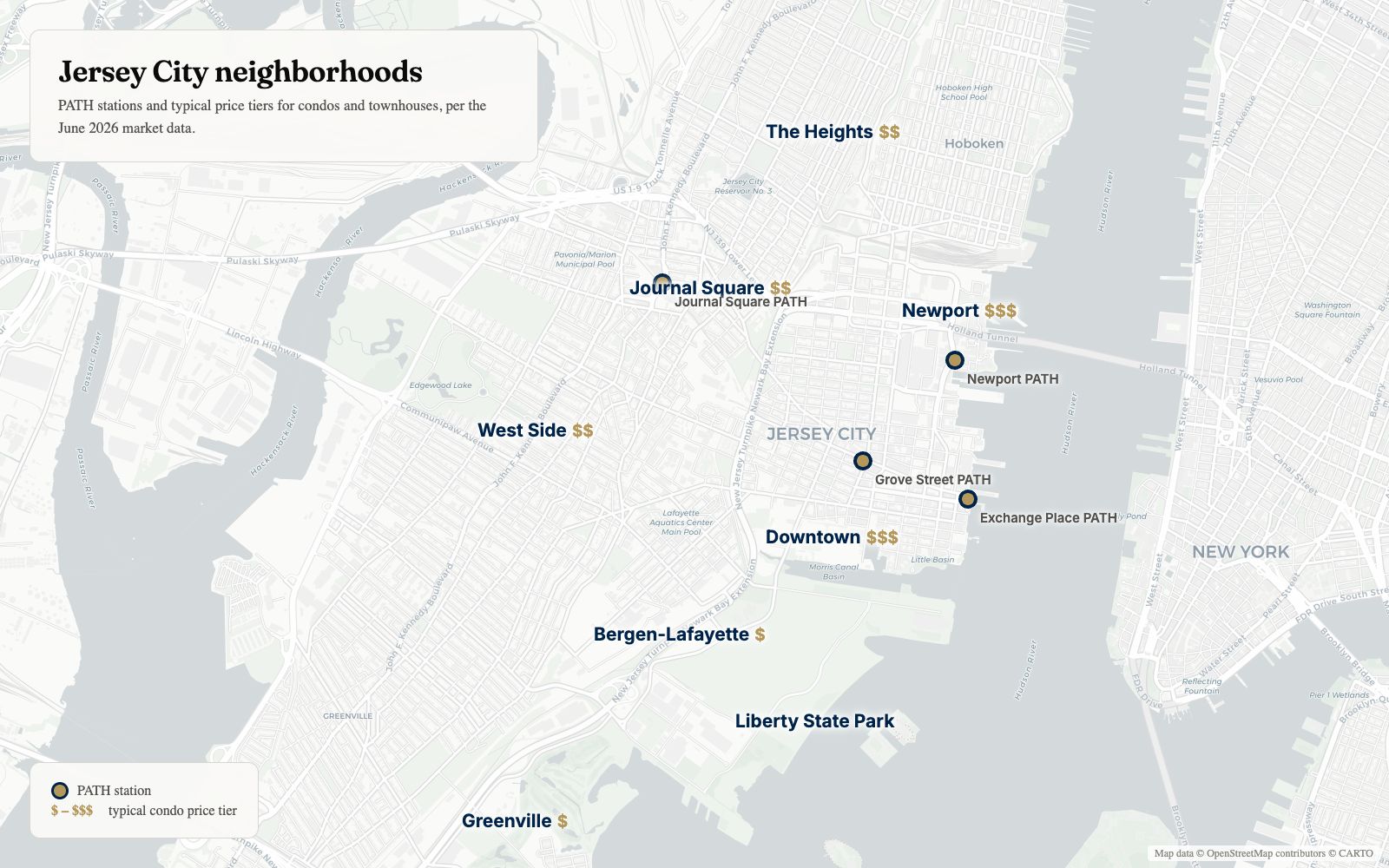
Median-price tier ($700,000-$750,000): This is where the median falls for both condos ($724,000) and single-family ($725,000). Expect two-bedroom units in mid-rise buildings, some with parking, most without concierge services. Journal Square and McGinley Square concentrate inventory in this band. Downtown one-bedrooms in older buildings also fall here.
Above-median tier: Two-bedrooms and small three-bedrooms in Downtown, The Heights with renovated townhouse units, and newer construction in Journal Square. This tier offers more amenity-rich buildings.
Premium tier: Large condos Downtown, waterfront units with views, and three-bedroom townhouses in Paulus Hook or The Heights.
Luxury tier: Single-family homes in Paulus Hook, penthouse condos at 99 Hudson Street, and the newest waterfront construction. This segment is thin on inventory with only 69 single-family homes available across the entire city as of June 2026.
| Property Type | Median Price (June 2026) | YoY Change | Inventory |
|---|---|---|---|
| Condo/Townhouse | $724,000 | +5.7% | 580 |
| Single Family | $725,000 | +4.0% | 69 |
The Search: How Listings Move in This Market
Jersey City homes for sale don't sit. Single-family properties average 24 days on market, down from 37 days last year (a 7.5% decrease in days on market year-to-date per the June 2026 market report). Condos average 35 days, down 2.8% year over year. Checking portals once a week means missing properties.
Portal limitations. The major listing sites show what's already on MLS. By the time a property syndicates to your saved search, it may already have offers. Set alerts for instant notification, not daily digests.
Pocket listings and pre-market. Some sellers prefer quiet sales to maintain privacy or test pricing before going public. A local broker with relationships in specific buildings hears about these first. This isn't a guarantee of inventory. It's an information edge.
New construction pipeline. Downtown and the waterfront continue to see development. New buildings mean new inventory, but they also mean longer timelines (most require several months from contract to closing) and different negotiation dynamics. Sponsors may cover some closing costs but hold firm on price.
The MLS math. With 580 condos and 69 single-family homes active in June, and 127 sales that month, supply sits at 5.5 months in condos and 3.4 months in single-family. That's balanced to slightly tight.
The Offer: What It Takes to Win
Jersey City sellers receive, on average, 99.5% of list price on condos and 100.7% on single-family homes. The single-family number tells you something. Buyers are paying over ask.
Price positioning. Properties priced right sell in the first few weeks. Listings that sit well past that mark often have pricing issues. Bidding on a listing that's been on market for over a month? Room to negotiate exists. Competing for a fresh listing with multiple showings? Expect to pay at or above ask.
Escalation clauses. In competitive situations, an escalation clause can work. Structure it with a cap you're genuinely comfortable hitting. "We beat the highest offer by $5,000 up to $760,000" tells the seller exactly where you stand.
Contingency trade-offs. In a balanced market, keeping the inspection contingency is reasonable. Jersey City isn't so frenzied that waiving everything becomes necessary. But a financing contingency with a strong pre-approval letter reads differently than one without.
Earnest money signals. Standard in New Jersey is 1-2% of purchase price. Putting 3% down as earnest money signals commitment without adding real risk (it's applied to your down payment at closing).
Inspection, Appraisal, Closing: What to Actually Expect
New Jersey has a unique buying process. Here's the timeline.
Attorney review (3 business days). After signing a contract, both buyer and seller have three business days for their attorneys to review and negotiate terms. This is standard in NJ. Not having a real estate attorney? Get one before making an offer.
Home inspection (within the first week or two). Schedule the inspection immediately after attorney review concludes. In Jersey City's condo market, inspecting the unit and reviewing the building's financials (reserve fund, pending assessments, litigation history) is essential. For townhouses and single-family, add structural concerns, roof condition, and mechanicals.
Appraisal (2-3 weeks). The lender orders an appraisal to confirm the property's value supports the loan. In a market with year-over-year appreciation, appraisals occasionally come in below contract price. Know your options: renegotiate, bring additional cash, or walk.
Clear to close (1-2 weeks). Final underwriting, title search, and document preparation. Jersey City closings typically happen within a couple of months from accepted offer, depending on financing complexity and building approval timelines for condos.
Condo board approval. Some Jersey City buildings require board approval before closing. This can add a week or two. Ask about approval timelines before making an offer.
Costs Beyond the Purchase Price
The sticker price is not your total cost. Here's what else to budget for.
Property taxes. Jersey City taxes are based on assessed value, not sale price. The city's average assessed value runs around $482,000, even on properties selling for significantly more. Your actual tax bill depends on your property's specific assessment. Budget for reassessment risk after purchase.
HOA fees. Condo fees in Jersey City range from under $400 monthly in older buildings to over $1,200 in full-service waterfront towers. These are fixed costs. They do not negotiate. Ask for the HOA's budget, reserve fund balance, and any pending special assessments before buying.
Closing costs. Budget 2-4% of purchase price. On a $724,000 condo, that's roughly $14,500 to $29,000. This includes title insurance, attorney fees, recording fees, and lender charges.
Transfer taxes. New Jersey charges a Realty Transfer Fee of roughly 1% on sales above $350,000. Sellers typically pay this, but it's negotiable.
Monthly carrying costs. For a $724,000 condo with standard down payment, factor in principal and interest, plus $400-$1,200 monthly HOA and property taxes based on assessed value. Total monthly carrying costs typically run $5,200 to $6,500 depending on your specific situation.
| Cost Category | Typical Range |
|---|---|
| Down Payment (varies) | 3.5%-20% of price |
| Closing Costs (~3%) | ~$21,720 |
| Monthly HOA | $400-$1,200 |
| Monthly Taxes (estimated) | $600-$1,000 |
Decision Frameworks: Which Buyer Are You?
If you're a first-time buyer: Targeting condos around the median price point makes sense. Journal Square and McGinley Square offer strong value per square foot. Expect to compete for updated units. Consider new construction with sponsor financing, which sometimes requires less down. Your priority: get pre-approved, understand your true monthly budget including HOA, and move fast on well-priced listings.
If you're moving up from a rental: Most of the condo market and entry-level townhouses become accessible. Downtown becomes realistic for two-bedrooms. Paulus Hook townhouses occasionally appear in this range. Your priority: decide whether a condo with amenities or a townhouse with space and no HOA fits better.
If you're relocating with significant equity or savings: Downtown condos, waterfront units, and single-family homes in Paulus Hook or The Heights are in reach. This tier has the least inventory but also the least competition. Your priority: understand the tax implications of your move and factor in the commute trade-offs.
If you're an investor looking at rental yield: Jersey City's median gross rent is $2,007, but this varies dramatically by neighborhood and unit type. Downtown two-bedrooms command significantly more. Run numbers on actual rental comps, not city-wide medians. Your priority: factor in vacancy rates, management costs, and the difference between gross and net yield.
Common Buyer Mistakes in This Market
Waiting without a clear catalyst. Jersey City showed 5.7% year-over-year appreciation on condos and 4% on single-family in the latest data. The market has shown positive trajectory. Waiting without a specific reason costs more than buying.
Underestimating HOA costs. A lower-priced condo with high monthly HOA costs more long-term than a slightly more expensive condo with lower HOA. Run the 10-year math.
Ignoring the commute. PATH runs to Lower Manhattan in roughly 20 minutes from Downtown. But working Midtown means adding a subway transfer or a bus. The Heights has light rail access but slower Manhattan travel. Live where your commute works.
Skipping building financials. That low HOA might reflect deferred maintenance. Ask for the reserve study. Ask about pending assessments. A well-funded building costs more monthly but protects you from surprise five-figure special assessments.
Assuming list price is real price. Single-family homes in Jersey City sold at 100.7% of list in June 2026. Only willing to pay ask? Competitive bids get lost.
Next Steps: Your Action List
-
Get pre-approved this week. Not pre-qualified. Pre-approved, with a commitment letter from a lender who understands the Jersey City market.
-
Define your must-haves and nice-to-haves. Commute under 30 minutes? Parking included? In-unit laundry? Know where to compromise.
-
Pick two neighborhoods to focus on. Spreading your search across all of Jersey City means never learning any market well enough to spot value.
-
Find a broker who works this market daily. Portal searches show what's public. A local broker shows what's coming, what's mispriced, and which buildings to avoid.
-
Tour at least five properties before bidding. Calibration matters. Seeing what $724,000 actually buys in Journal Square versus Downtown changes how you evaluate listings.
-
Run the full monthly cost calculation. Mortgage, taxes, HOA, insurance, parking. If the total exceeds 35% of your gross income, that's stretching.
Thinking about buying in Jersey City? We can pull the specific comparables for your target building or neighborhood and walk you through the current window.
Frequently Asked Questions
How much do homes cost in Jersey City right now?
The median condo price hit $724,000 in June 2026, up 5.7% year over year. Single-family homes landed at $725,000 median, up 4%. Journal Square and McGinley Square offer options at various price points, while Downtown and waterfront command premiums.
Is Jersey City a good place to buy a home in 2026?
The June 2026 data shows 5.7% condo appreciation and 4% single-family appreciation year over year. PATH access to Lower Manhattan in roughly 20 minutes, combined with distinct neighborhood character, makes the value case clear for buyers evaluating the region.
Which Jersey City neighborhood is best for first-time buyers?
Journal Square and McGinley Square offer strong value with improving transit infrastructure. The Heights has townhouse inventory at lower price points than Downtown, appealing to buyers seeking more space without the waterfront premium.
How long does it take to buy a home in Jersey City?
From accepted offer to closing, expect roughly two months. Single-family homes currently sell in 24 days on average. Condos take 35 days to go under contract. Add attorney review, inspection, and financing for the full timeline from offer to keys.
Are Jersey City property taxes high compared to other NJ cities?
Taxes are based on assessed value, not sale price. Jersey City's average assessed value runs around $482,000. The effective rate means many buyers pay less than they expect based on their purchase price, though reassessment risk exists.
Should I buy a condo or townhouse in Jersey City?
Condos offer amenities and lower maintenance but carry monthly HOA fees ranging from $400 to $1,200. Townhouses eliminate HOA but require handling repairs, snow removal, and exterior maintenance. The choice depends on lifestyle and maintenance tolerance.
What are the best Jersey City neighborhoods for commuting to Manhattan?
Downtown and Paulus Hook offer the fastest PATH access, with trains to Lower Manhattan in roughly 20 minutes. Journal Square connects via PATH as well. The Heights has Hudson-Bergen Light Rail but requires a transfer for Manhattan-bound travel.
How competitive is the Jersey City market for buyers?
Condos sell at 99.5% of list price. Single-family homes sell at 100.7%, meaning buyers typically pay over asking. With 35 days average on market for condos and 24 for single-family, well-priced properties move quickly.