
Selling a Home in Hoboken NJ: An Appraiser's Pricing Guide
Hoboken condo median sale price hit $1,030,000 in May 2026, up 15.7% year over year, and well-priced units moved in just 12 days. That's the headline. But if you're thinking about selling a home in Hoboken NJ, the number that matters most is the one the buyer's lender will put on their appraisal report. I've spent over 20 years in this market as a broker and state-certified residential appraiser. Today I'm a Broker Associate with Prominent Properties Sotheby's International Realty, and that dual lens shapes how I help sellers price their homes. Let me walk you through what actually determines value here, and how to position your sale so the appraisal supports your price instead of killing your deal.
Market data sourced from Hudson County MLS through May 2026.
What I See When I Value Your Hoboken Home
Square footage matters, but it's rarely the whole story. When I walk through a Hoboken condo or brownstone, I'm looking at the same factors any appraiser will consider, and they're worth understanding before you pick a list price.
Views command premiums. A unit facing the Manhattan skyline or the waterfront will appraise higher than an identical floor plan facing a brick wall. The adjustment can run $50,000 or more depending on the building and floor.
Outdoor space is scarce. Hoboken is one square mile. A private balcony, rooftop access, or deeded backyard adds real value because supply is structurally limited. Appraisers adjust for this.
Parking changes the math. A deeded parking spot in a building like Maxwell Place or Hudson Tea adds significant value to your home's price. The exact premium varies by building and location, but it's substantial enough that appraisers always account for it.
Building financials matter more than you think. Lenders require appraisers to review HOA reserves and recent assessments. A building with thin reserves or pending special assessments will face financing hurdles. Buyers' lenders may require higher down payments or decline to lend entirely. This affects your buyer pool and, by extension, what your home can sell for. Note that HOA fees themselves are fixed monthly costs set by the association and are not negotiable in a sale.
Condition adjustments are real. An original 2008 kitchen in a building that's seen full renovations in competing units will cost you. Appraisers pull comparables from the same building when possible. If unit 4B sold for $1.1M with a gut renovation and your unit 5B has the original finishes, expect a downward adjustment.
These are the factors that drive appraised value. Understanding them before you list helps you price realistically and avoid surprises at the finish line.
Selling a Home in Hoboken NJ: What the May 2026 Numbers Tell Sellers
Here's what the data shows for sellers right now:
Hoboken May 2026 Market Snapshot
| Property Type | Median Sale Price | YoY Change | DOM | Sales Volume |
|---|---|---|---|---|
| Condo/Coop/Townhouse | $1,030,000 | +15.7% | 12 | 41 |
| Single Family | $3,912,500 | +247.8% | 37 | 2 |
Condos are moving fast. 41 sales in May 2026, with days on market at just 12. That's down from 14 the prior year. Sellers who price correctly are closing in under two weeks.
Single-family is a different story. Only 2 sales in May, with a median of $3,912,500. Days on market stretched to 37. Higher price points mean smaller buyer pools and longer marketing periods. If you're selling a brownstone, expect a slower timeline and plan accordingly.
List-to-sale ratios remain strong. Condos sold at 101.6% of list price in May 2026. That means well-priced homes are attracting multiple offers and closing above ask. But that ratio rewards accurate pricing, not aspirational pricing. Overpriced listings sit, and when they finally sell, they often net less than a correctly-priced home would have from day one.
Inventory is rising. Condo inventory hit 101 units in May 2026, up 38.4% year over year. Months of supply sits at 2.2, still a seller's market, but buyers have more options than they did a year ago. Pricing discipline matters more now.
How the Buyer's Lender Appraisal Will Judge Your Price
Here's what most sellers don't fully understand: your buyer's lender will order an independent appraisal, and that appraiser doesn't care what you think your home is worth. They care about what the data supports.
The comparable sales lookback. Appraisers pull comparable sales from recent months, prioritizing sales in the same building when available. For a Hoboken condo, that usually means three to five recent closings in your building or immediate neighborhood. If those comps don't support your contract price, the appraisal comes in low.
Adjustments are granular. The appraiser will adjust each comp for differences: square footage, floor level, views, outdoor space, parking, condition, and building amenities. A comp that sold for $1.2M but has 200 more square feet, a parking spot, and a renovated kitchen might only support $1.05M for your unit after adjustments.
Contract price doesn't equal appraised value. A buyer might agree to pay $1.15M because they love your unit. But if the appraisal comes in at $1.08M, the lender will only lend based on the lower number. The buyer either brings more cash to close, you renegotiate the price, or the deal falls apart.
This is why I advise sellers to think like an appraiser before they pick a list price. The goal isn't to find a buyer willing to pay a number. The goal is to find a buyer whose lender will support that number.
If you're navigating contract contingencies and want to understand how appraisal gaps are typically handled, a real estate attorney can walk you through your options before you sign.
The Real Cost of Overpricing in Hoboken
I'll be direct: overpricing costs you money. Not just time. Money.
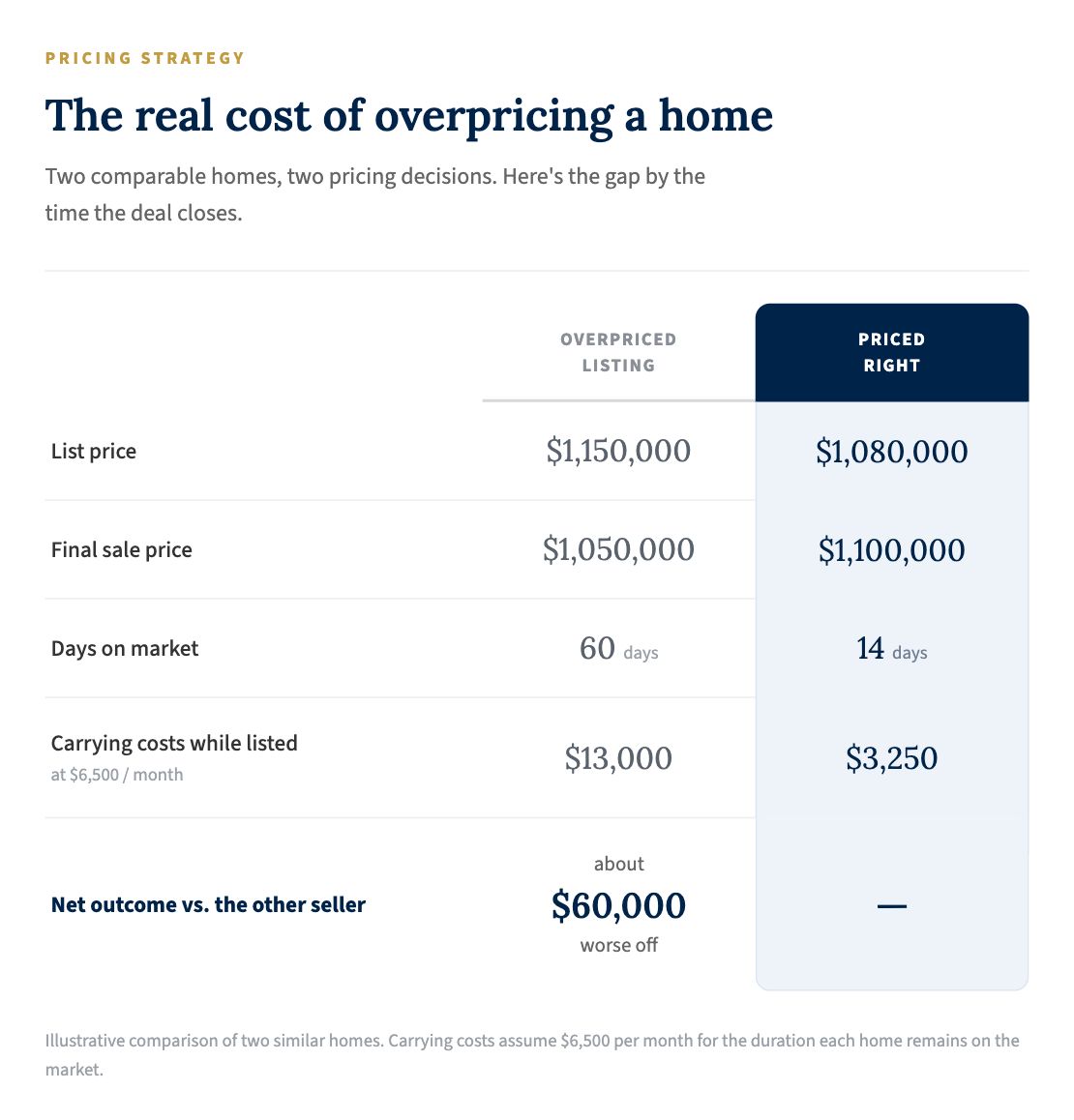
The math on carrying costs. If your condo has a $1,200 monthly HOA fee, $800 in property taxes, and you're paying a $4,500 mortgage, every month your home sits unsold costs you $6,500 out of pocket. Two months of overpricing costs $13,000. That's $13,000 you didn't need to lose if you'd priced correctly from the start.
Buyer perception shifts fast. In Hoboken's condo market, 12 days on market is normal for a well-priced unit. By day 30, buyers start asking what's wrong with it. By day 45, your listing is stale. The only way to revive interest is a price reduction, which signals to the market that you were wrong about value. Buyers who see a price drop often offer below the new asking price, figuring there's more room to negotiate.
The net result. A home listed at $1.15M that sits for 60 days, then reduces to $1.08M, and finally sells at $1.05M nets less than a home listed at $1.08M that sells in two weeks at $1.1M. The first seller lost two months of carrying costs and $50,000 in sale price. The second seller moved fast and captured a premium from competitive interest.
Price correctly from day one. The market will tell you if you're wrong within the first two weeks. But starting high and chasing the market down is the most expensive mistake sellers make.
Pricing Strategy for Condos vs. Brownstones vs. Townhouses
Different property types require different approaches to pricing.
Condos have abundant comps. With 192 condo sales year-to-date through May 2026, there's usually recent comparable data in your building or a similar building within blocks. This makes pricing more precise. You can look at what unit 3A sold for in April, adjust for your floor level and condition, and arrive at a defensible number.
Brownstones are trickier. Only 10 single-family sales year-to-date. When comps are thin, appraisers have to reach further, pulling sales from different blocks or different configurations. This introduces more uncertainty. If you're selling a brownstone, expect more variance in buyer offers and be prepared to explain your pricing rationale.
Building-specific factors weigh heavily on condos. HOA reserves and recent or pending assessments affect what lenders will finance and what buyers will pay. Before you list, get a copy of your building's most recent reserve study and board meeting minutes. If there's a special assessment coming, buyers will find out during due diligence. Better to price it in than have it kill a deal.
Townhouses split the difference. More comps than brownstones, but not as many as condos. Focus on recent sales within the same block or same vintage of construction. Outdoor space, parking, and lot size matter more here than in condo pricing.
When to Sell: Timing Considerations for Hoboken Sellers
Let me take a position on timing, because "it depends" doesn't help you plan.
Spring launches perform best. March through May sees the highest buyer activity in Hoboken. NYC bonus checks hit accounts in Q1. More buyers mean more competition for your listing, which supports price.
Fall is the second window. After Labor Day through mid-November, buyers who missed the spring market get active again. Inventory drops as sellers who didn't sell in spring delist. If you can't hit the spring window, fall is your next best shot.
Summer and winter are slower. July and August, Hoboken empties out on weekends. December through February, holidays and weather suppress activity. You can sell in these months, but expect longer days on market and potentially less competitive offers.
Lead time matters. If you want to launch in early April, start prep in January. Decluttering, staging, photography, and pre-listing inspections take 6-8 weeks to do well. Rushing to market with poor photos and unfinished prep costs you money.
Preparing Your Home: What Actually Moves the Needle
Not every improvement returns its cost. Here's what actually matters in Hoboken.
Laundry in unit. If you don't have it and can add it, do it. In-unit washer/dryer is the single most searched feature for Hoboken condos. The return on this investment typically exceeds the installation cost.
Storage optimization. Closet systems, built-ins, and creative storage solutions matter in small spaces. Buyers mentally add or subtract based on how much stuff they can fit.
HVAC upgrades. A building with central air is one thing. A condo that added ductless splits for zone control is another. In older buildings without central systems, ductless AC is expected at higher price points.
Outdoor space optimization. If you have a balcony or patio, stage it. A rusted grill and dead plants don't help. A clean outdoor dining setup with plants photographs well and signals livable space.
What doesn't move the needle. Full kitchen renovations rarely return 100% of cost unless the existing kitchen is genuinely dated or damaged. High-end appliance upgrades mostly benefit you while you live there, not at resale. Bathroom cosmetics like new hardware and paint help; full gut renovations often over-improve for the building's price point.
A professional staging consultation can help you identify the five or six things that will actually affect buyer perception in your specific unit.
What to Expect During Showings and Feedback Loops
The first two weeks on market tell you everything.
Week one: high activity is the goal. A well-priced, well-photographed listing should generate 8-15 showing requests in the first week. If you're seeing 2-3, something is off. Either price, presentation, or both.
Week two: calibrate based on feedback. Your agent should be collecting buyer and agent feedback after every showing. "Love the layout, price feels high" from multiple parties is a signal. "Great price, but needs updates" is different information. Adjust accordingly.
Week three: decision time. If you haven't received an offer by week three in Hoboken's current market, a price adjustment is probably necessary. The longer you wait, the more stale the listing becomes. Better to reduce by 3% at day 21 than by 5% at day 45.
This isn't about panic. It's about reading the market in real time and responding.
Offers and Negotiation: Beyond the Headline Number
When offers come in, price is one factor. It's not the only one.
Financing type matters. A cash offer at $1.08M may net you more than a financed offer at $1.12M if the financed buyer's appraisal comes in low and you have to renegotiate. Cash offers also close faster with fewer contingencies.
Contingencies carry risk. An offer contingent on the buyer selling their current home introduces uncertainty. A financing contingency is standard, but the strength of the buyer's pre-approval matters. Ask for proof of funds and lender pre-approval letters with specific loan amounts.
Timeline flexibility has value. A buyer who can close in 30 days may be worth more than one who needs 60. Conversely, if you need time to find your next home, a buyer willing to do a 60-day close or a post-closing possession agreement has value you can negotiate for.
Escalation clauses need caps. In a competitive situation, buyers often submit escalation clauses. Make sure any escalation has a clear cap and increment. "I'll beat the highest offer by $5,000 up to $1.15M" is workable. "I'll match any offer" is not.
Inspection, Appraisal, and Closing: Common Seller Surprises
Inspection issues in older buildings. Pre-war brownstones and early-2000s condos surface issues: aging HVAC, window seals, roof conditions in townhouses. Consider a pre-listing inspection to identify problems before a buyer's inspector does. You can either fix issues or price them in.
Appraisal gaps happen. In a rising market, appraisals sometimes lag. If your contract price is $1.12M and the appraisal comes in at $1.08M, you'll negotiate. Options: buyer brings additional cash, you reduce price, or you meet in the middle. Know your walk-away number before offers come in.
Closing costs aren't trivial. In New Jersey, sellers typically pay transfer taxes (approximately 1% of sale price), their own attorney fees, prorated property taxes, and the real estate commission. On a $1.1M sale, budget $70,000-$80,000 for closing costs. Your net is not your sale price.
Title issues delay closings. Old liens, estate complications, and boundary disputes surface during title search. If you know of any title issues, disclose them early and get them cleared before you list.
Common Seller Mistakes in This Market
Overpricing based on automated estimates. Online valuations don't account for condition, views, or building-specific factors. They're a starting point, not a pricing strategy.
Listing without prep. Poor photos, cluttered rooms, and deferred maintenance cost you. The first 48 hours online are when your listing gets the most eyeballs. Don't waste them.
Ignoring early feedback. If three buyers say the same thing, it's not three wrong opinions. It's market data.
Emotional anchoring to a number. "I paid $950,000, so I need to sell for $1.1M" isn't how markets work. Your home is worth what a buyer will pay and a lender will finance today, not what you need it to be worth.
Choosing an agent based on highest price suggestion. Some agents will tell you what you want to hear to get the listing. Then your home sits, you reduce, and you end up selling for less than if you'd priced correctly with an honest agent. Ask agents to show you comparable sales and defend their price recommendation. If they can't, walk away.
For more context on how neighborhoods within Hoboken affect pricing, see my Hoboken Neighborhoods: 2026 Guide to Your Perfect Fit.
FAQ
How do I know if my Hoboken condo will appraise at my asking price?
Pull comparable sales from your building or similar buildings within recent months. Adjust for differences in square footage, floor level, views, parking, and condition. If the comps support your price after adjustments, you're likely fine. If you're reaching, expect appraisal risk. Through May 2026, Hoboken condos had 192 year-to-date sales, so comparable data is readily available for most buildings.
What happens if the buyer's appraisal comes in lower than our agreed price?
You have three options: the buyer brings additional cash to cover the gap, you reduce the price to match the appraisal, or you meet somewhere in the middle. If neither side will budge, the deal falls through. In Hoboken's current market, with condos selling at 101.6% of list price, appraisal gaps are less common on correctly-priced homes, but they do happen in competitive bidding situations.
How long does it typically take to sell a condo in Hoboken right now?
Well-priced condos averaged 12 days on market in May 2026, down from 14 the prior year. Overpriced listings take significantly longer. Year-to-date DOM sits at 22 days, indicating that even with some slower periods, correctly-priced condos move quickly.
Should I renovate before selling my Hoboken home?
It depends on what's dated. In-unit laundry, if you can add it, typically returns more than its cost. Minor kitchen updates like hardware and paint help. Full gut renovations rarely return 100% unless your finishes are genuinely damaged or decades old. Focus on clean, decluttered presentation and fix obvious maintenance issues.
What's the difference between a broker price opinion and an appraisal when pricing my home?
A broker price opinion is what your listing agent prepares using recent sales, active listings, and market knowledge to suggest a list price. An appraisal is a formal valuation by a licensed appraiser, ordered by the buyer's lender to verify the home's value supports the loan amount. Both use comparable sales, but appraisals follow stricter USPAP guidelines and directly affect financing approval.
Do I need to disclose my Hoboken condo's HOA financial situation to buyers?
Yes. New Jersey requires disclosure of material facts, and HOA financial health qualifies. Buyers will receive HOA documents during attorney review anyway, including reserve studies and meeting minutes. If there's a pending special assessment or thin reserves, disclose it upfront. Surprises during due diligence kill deals. Pricing the issue in from the start is smarter than losing a buyer at the finish line.
What are the closing costs for sellers in Hoboken?
Sellers pay transfer taxes (approximately 1% of sale price), their own attorney fees ($1,500-$3,000), prorated property taxes, and the real estate commission. On a $1.1M sale, expect $70,000-$80,000 in total closing costs. Your net proceeds are your sale price minus these costs and your remaining mortgage balance.
Is now a good time to sell in Hoboken?
Yes. Condo median price rose 15.7% year over year to $1,030,000 in May 2026, and days on market dropped to just 12. Inventory is rising (up 38.4% YoY to 101 units), which means buyers have more choices. Selling now captures the price appreciation while demand remains strong. Waiting risks more competition from other sellers and potential rate-driven buyer hesitation if mortgage rates move.
Let's Have a No-Pressure Pricing Conversation
If you're thinking about selling, I'm happy to sit down and walk through the numbers for your specific home. No pitch, no pressure. Just an honest look at what comparable sales support, what an appraiser will see, and what you can realistically expect to net. I've found the best conversations happen across a kitchen table with real data on the screen. Reach out when you're ready.