
Spring listings in Bergen County get priced in winter. A pre listing appraisal New Jersey sellers commission in November or December gives them a value built under the same professional standards a lender's appraiser follows, months before a buyer's contract puts pressure on the number. Market conditions shape both appraised values and pricing strategy, and nobody can promise what spring 2027 will look like. A documented starting point still helps. Keep one thing in mind from the start: an appraisal is an unbiased opinion of value. It is not a negotiation tool, and it is not a listing pitch.
 Photo: JERRYE & ROY KLOTZ, M.D. / Wikimedia Commons, CC BY-SA 4.0
What Determines It: Pre Listing Appraisal New Jersey Fees
Where a home lands in our fee range comes down to five factors: property type, size, complexity, turnaround, and intended use. Standard condos sit toward the lower end. Complex, oversized, or unusual properties are quoted individually once the scope is clear.
Bergen County's 70 municipalities cover a wide spread of housing types, which is why no single flat fee fits every assignment.
Property type. A condo in Fort Lee or Englewood Cliffs has fewer components to measure and document than a detached home. A two-family house in Rutherford or Lyndhurst adds a rental component, since income affects value. More components mean more analysis.
Size and land. A large home on acreage in Alpine or Franklin Lakes takes longer to measure and photograph. It also tends to have fewer truly comparable sales nearby. Scarcity of comparables is exactly where a certified opinion is most useful.
Complexity. Plenty of Bergen County homes don't fit a template. Think of a custom rebuild in Tenafly on a block of original capes, a finished basement with no permit on file, or a lot inside a FEMA-designated flood zone, which affects the insurance costs buyers will weigh. Each one adds research and adjustments.
Turnaround and intended use. A rush request during the spring rush is different from a standard schedule. Intended use matters too. A retrospective valuation for an estate requires research into a past market, not today's. The clearer the purpose at booking, the cleaner the quote.
Weigh the fee against the alternative. A home listed above what the evidence supports can sit through the first few weeks of peak buyer traffic, and the price reductions that follow often cost tens of thousands of dollars more than the appraisal would have.
Appraisal vs Broker Price Opinion vs Online Estimate
There are three tools, each with its own job. An online estimate is free and instant but never sees inside the home. A broker price opinion, which some sellers know as a CMA, is an agent's informed professional judgment. An appraisal is a signed, USPAP-compliant valuation by a state-certified appraiser, and it is the only one of the three that is legally defensible.
| Private appraisal | Broker price opinion | Online estimate | |
|---|---|---|---|
| Cost | Private-pay fee set by scope | Usually no charge from a prospective listing agent | Free |
| Who performs it | State-certified or licensed appraiser | Real estate agent | Algorithm |
| Standard | USPAP, signed report | Agent's judgment | None |
| Interior inspection | Yes | Usually a walkthrough | No |
| Timing | Days, confirmed at booking | Same day to a few days | Instant |
| Best fit | Estates, divorce, tax appeals, unusual homes, price disputes | Most standard listings | Early curiosity |
USPAP stands for the Uniform Standards of Professional Appraisal Practice. It's the rulebook requiring appraisers to stay impartial, document their reasoning, and disclose any interest in the property or the parties. It also requires the appraiser to keep a workfile supporting each report for at least five years, which is part of why a signed appraisal holds up later.
Online estimates are a reasonable first look. They just can't see a renovated kitchen or a roof at the end of its life. By contrast, a good broker price opinion reads current competition and buyer behavior, which an appraisal deliberately sets aside. An appraisal rests on closed sales and documented adjustments, so it holds up when someone challenges the number. Sellers who want a no-cost starting point can request a New Jersey home valuation before deciding whether a full appraisal is worth it.
When You Actually Need an Appraisal
Not every seller needs one. A three-bedroom colonial in Westwood with several recent sales on similar streets can usually be priced well from a broker price opinion. A full appraisal makes sense in six situations.
Pre-listing price disagreements. When siblings, spouses, or a seller and agent can't agree on a number, an independent appraisal resets the conversation around evidence. A neutral report lets everyone argue from the same set of comparable sales.
Estate settlement. Executors often need a value as of the date of death for IRS Form 706, which is generally due nine months after death, or as of the alternate valuation date six months later under IRC §2032. Heirs usually want defensible documentation before anyone agrees on a list price. Our estate property valuation page covers the details.
Divorce. When one spouse keeps the house or the sale proceeds are divided, attorneys typically want a signed report, not an opinion. An appraisal provides a value both sides can review.
Property tax appeals. Appeals go to the Bergen County Board of Taxation, generally by April 1, or 45 days after assessment notices are mailed if that date is later, and by May 1 in a year when the town completes a municipality-wide revaluation. Properties assessed above $1 million can file directly with the New Jersey Tax Court. Relief generally applies when the assessment falls outside a 15% range around the county's common level ratio. Taxes are based on assessed value, not the most recent sale price, and a certified appraisal is the standard evidence for challenging an assessment.
PMI removal. Under the federal Homeowners Protection Act, borrowers can request private mortgage insurance cancellation once the loan reaches 80% of the home's original value, and it ends automatically at 78%. When the request is based on appreciation instead, some lenders will consider a current appraisal. Lender rules vary, so confirm their requirements first.
Unusual properties. Custom homes, mixed-use buildings, large lots, and heavily renovated houses rarely have clean comparables. That's where an algorithm, and sometimes a quick broker opinion, can miss.
What Happens During an Appraisal
The process runs in five steps: scope, documents, the site visit, research, and the written report. Most typical Bergen County single-family appraisals move from visit to finished report within days, though timing depends on property complexity and season and is confirmed at booking.
Step one: scope. We confirm the purpose, the effective date, and the property type. A pre-listing appraisal uses today's date. An estate appraisal may look backward.
Step two: gather documents. Useful items include the deed (available from the Bergen County Clerk), a survey, permits for finished basements or additions, a list of improvements with dates and approximate costs, the current tax bill, and HOA documents for condos. Permits matter. An unpermitted addition is treated differently than a permitted one.
Step three: the walkthrough. The appraiser measures, photographs each room, and notes condition, systems, and updates. Clear access to the attic, basement, and mechanicals. Fix small, obvious items like dripping faucets or missing outlet covers. That said, don't start a renovation for the appraisal. Appraisers rate condition and quality, not clutter or decor.
Step four: research. The appraiser selects closed comparable sales, usually from recent months, and adjusts for differences in size, condition, lot, and location. Location factors in this market include proximity to NJ Transit rail stations in towns like Ridgewood and Rutherford, commute access to New York City, school district boundaries, flood zone status, and traffic exposure.
Step five: the report. The signed report states the value conclusion, the comparable sales used, and every adjustment behind the number. Sellers can read exactly why the value landed where it did, and can bring documentation if a permitted improvement was missed.
Using the Appraisal to Set Your Listing Price
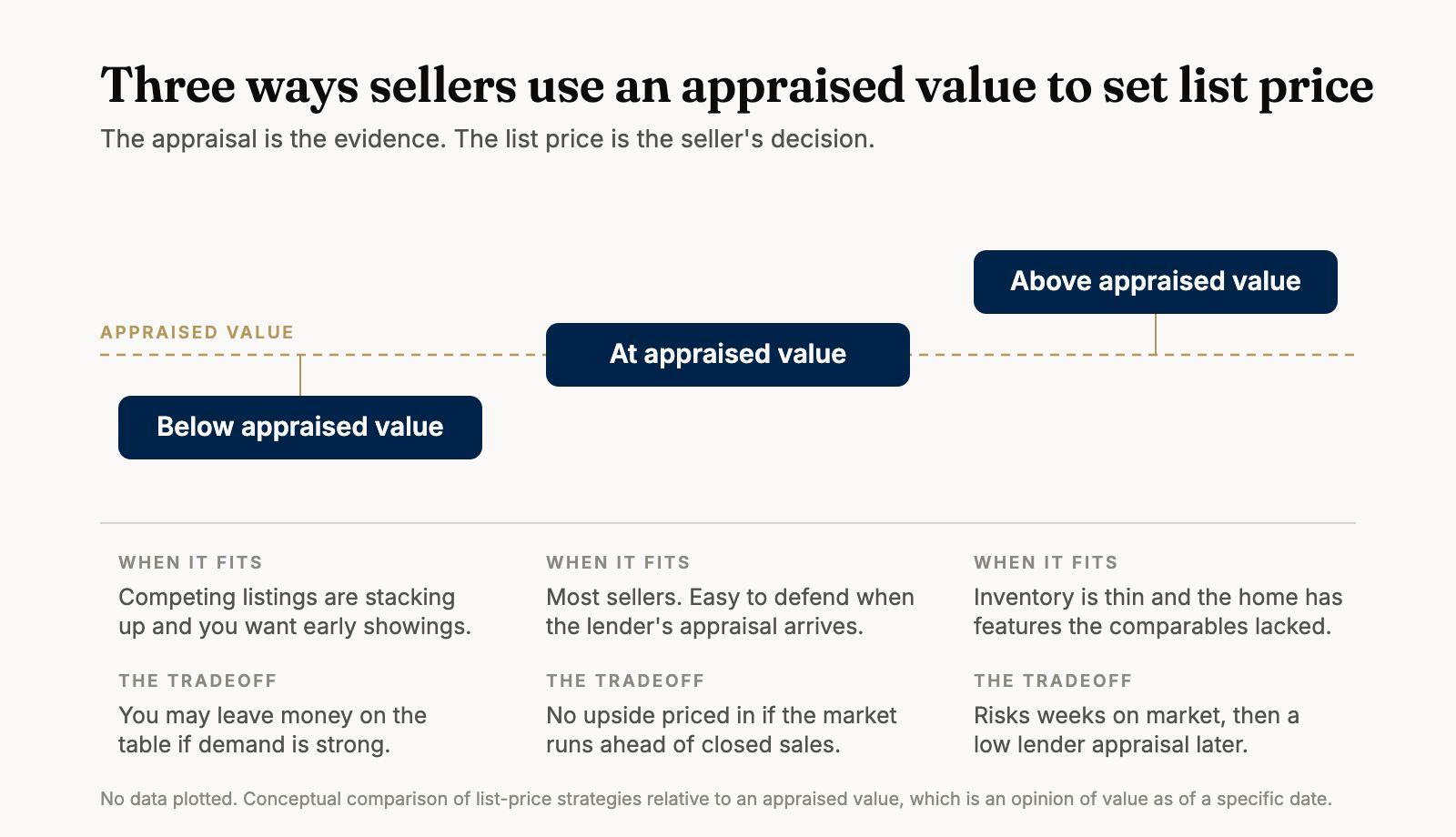
The appraised value is a starting point for list price, not the list price itself. An appraisal looks back at closed sales. Pricing looks forward at what buyers will see on the market the week the home goes live.
Sellers can weigh three approaches. Pricing at the appraised value signals confidence and is easy to defend when the buyer's lender appraisal arrives. Pricing modestly above it can make sense when inventory is thin and the home has features recent comparables lacked. Pricing slightly below it can draw more showings in the first few weeks when competing listings are stacking up. In practice, spring inventory tends to grow, which gives buyers more options and makes accurate pricing more important for sellers.
The appraisal sets the evidence. The list price decision belongs to the seller, usually alongside a listing agent reading the competition. Sellers who want that market read can book a pricing strategy consultation as a separate conversation.
Common Misconceptions
"An appraisal guarantees my sale price." It doesn't. It's an opinion of value on a specific date. Buyers, competition, and timing still decide the final number.
"My appraisal replaces the buyer's appraisal." The buyer's lender orders its own independent appraisal regardless. Lender independence rules require it, and the seller has no role in choosing that appraiser.
"Renovating right before the appraisal raises the value dollar for dollar." Rarely. Many improvements return less than they cost. Documenting completed work matters more than rushing new projects.
"Online estimates are useless." They aren't. They're a fair first look, and they cost nothing. They simply can't account for condition or features they've never seen.
FAQ
How much does a pre-listing appraisal cost in Bergen County?
We charge $450 to $750 for a typical single-family home. Standard condos fall toward the lower end. Complex, oversized, or unusual properties, such as large lots in Alpine or mixed-use buildings, are quoted individually after the scope is confirmed.
How long does a pre-listing appraisal take to complete?
For a typical Bergen County single-family home, the site visit is one appointment and the report usually follows within days. Timing depends on size, complexity, and season, so the turnaround is confirmed at booking. Spring and estate work can take longer.
Will the buyer's lender accept my pre-listing appraisal?
No. The buyer's lender orders its own independent appraisal under lender independence rules, and the seller does not select that appraiser. A pre-listing appraisal still helps, since a list price grounded in closed sales is less likely to face a low lender appraisal later.
Should I get an appraisal or just trust my agent's price opinion?
For a standard home with several recent comparable sales nearby, a broker price opinion is usually enough. An appraisal fits estates, divorce, tax appeals, unusual properties, and any situation where the parties disagree on value and need a signed, USPAP-compliant report.
What if my pre-listing appraisal comes in lower than expected?
Review the comparables and adjustments in the report first. If a permitted improvement was missed, provide the documentation. Otherwise, a lower value is useful information: listing near it avoids weeks on market and price cuts during peak spring buyer traffic.
Do I have to share my pre-listing appraisal with buyers?
No. A private-pay appraisal belongs to the client who ordered it. Some sellers share it to support their price, while others keep it private. New Jersey disclosure obligations about known property defects still apply either way, so discuss specifics with your attorney.
Can a pre-listing appraisal support a property tax appeal?
Often, yes. Bergen County appeals go to the Bergen County Board of Taxation, generally by April 1, or May 1 in a revaluation year. Properties assessed above $1 million can file directly with the New Jersey Tax Court. A certified appraisal is the standard evidence.
Request an Appraisal Quote
Planning a spring 2027 sale, settling an estate, or preparing a tax appeal in Bergen County? Send us the property address, the property type, and what the appraisal is for. We'll confirm the scope, quote the fee, and set a site visit date, so you know exactly what you're getting before you commit.
If you already know you need a signed, independent value before setting a list price, schedule a licensed NJ home appraisal.
Hero photo: Dougtone / Wikimedia Commons, CC BY-SA 2.0