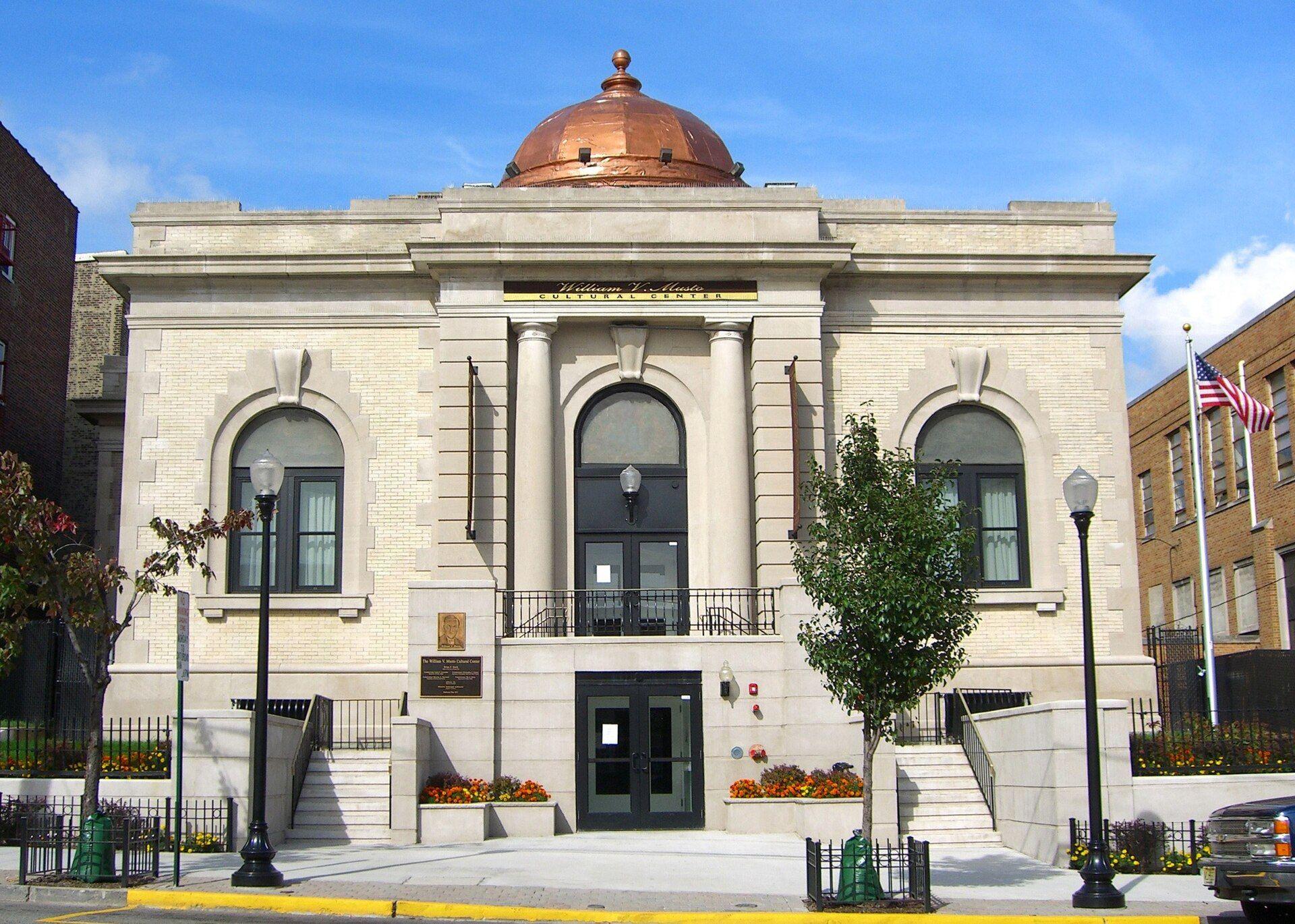
Bus brakes hiss along Bergenline Avenue, and the smell of sugar and dark-roast coffee drifts out of a bakery window where a line has already formed. Someone orders a cafecito without breaking stride. A delivery truck double-parks. Above the storefronts, 3 and 4 stories of brick lean shoulder to shoulder, fire escapes catching the light. This is the Union City NJ housing market before you open a single listing: a city where residents walk, ride the bus, and shop on the block because the block has everything.
Union City is the most densely populated city in New Jersey, packed into roughly 2 square miles between Weehawken, West New York, North Bergen, Hoboken, and Jersey City. It is not a suburb. It does not pretend to be one. That honesty is part of the appeal.
For pricing context, the Hudson County median sale price was $751,817 in September 2026, per Redfin. That is a county-wide figure, not a Union City number, and it blends waterfront towers with everything else in the county. Union City's mix of walk-ups, small multifamily homes, and condo conversions follows its own logic. For town-level detail, the Union City NJ real estate market Q3 2026 analysis breaks down what has actually traded.
The Lay of the Land in the Union City NJ Housing Market
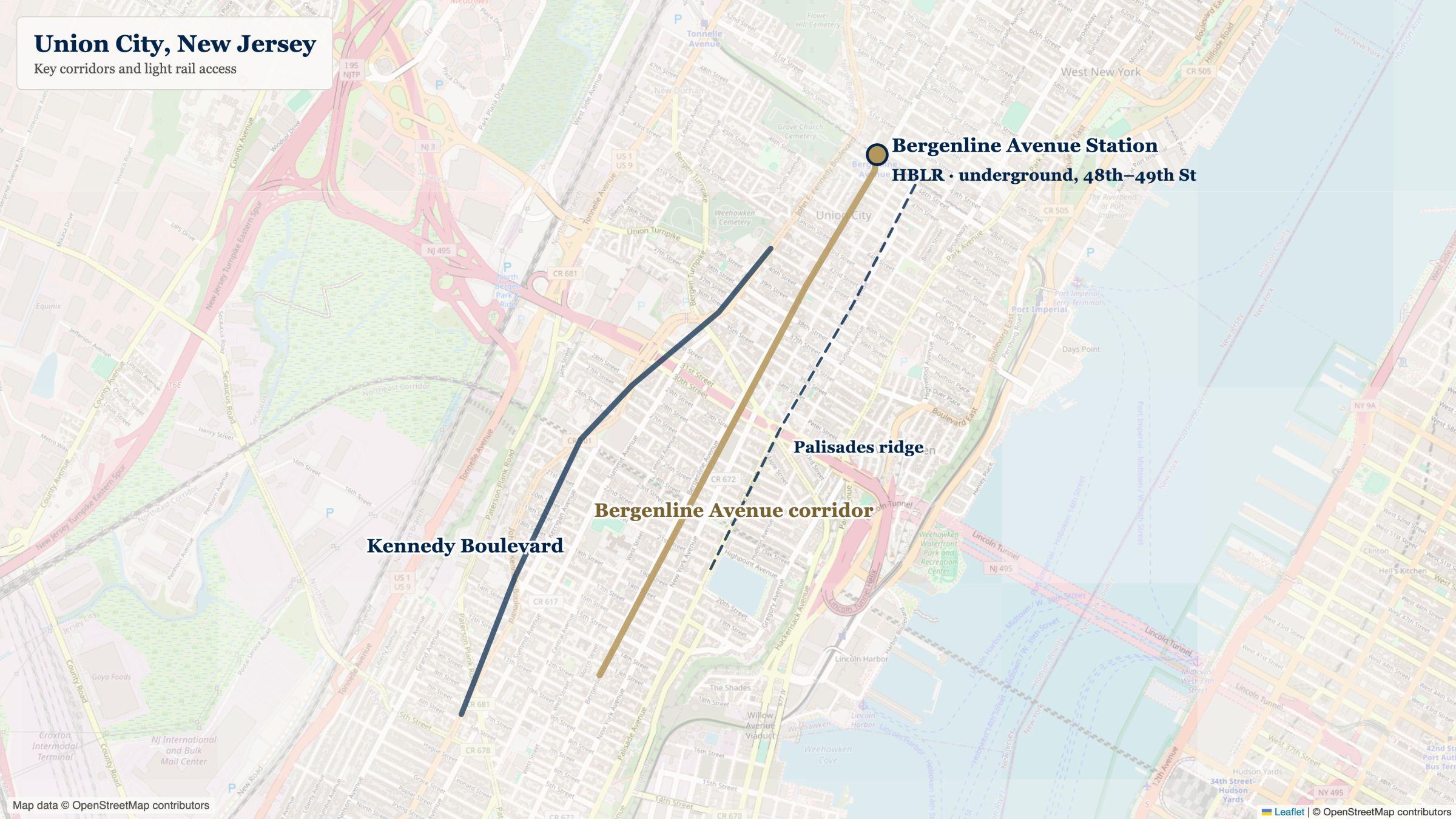
Union City reads best as 4 pockets, not one town: the Palisades ridge on the east, the Bergenline corridor through the middle, the John F. Kennedy Blvd side on the west, and the North End near North Bergen and West New York. Each has different light, different noise, and different housing types.
Start on the east side. Palisade Avenue and Mountain Road run along the Palisades ridge, and this is where Manhattan shows up between buildings. The views are the draw. Some blocks catch the Midtown skyline straight on; others get a sliver between rooftops. Boulevard East is close by, though it sits just over the line in Weehawken and West New York, not in Union City. In practice, ridge buyers are paying for sightlines and light, and those vary unit by unit, even floor by floor.
By contrast, the Bergenline corridor is the commercial spine. Bergenline Avenue is one of the busiest commercial corridors in New Jersey, running north through the city toward West New York and North Bergen, with storefronts on the ground floor and apartments above. Living on Bergenline itself means the city is your front porch. Living a block off it, on Park Avenue or New York Avenue, puts the same shops 2 minutes away with less foot traffic under your window.
Head west and the scale shifts toward John F. Kennedy Blvd. The boulevard is wider and carries more car traffic, and the side streets around it hold a mix of multifamily homes and small apartment buildings. It borders North Bergen, and the edge between the two is easy to miss on foot.
The North End has one practical edge: the Hudson-Bergen Light Rail Bergenline Avenue station at 48th Street. That stop matters. It is the closest thing Union City has to a rail station, and blocks within walking distance of it carry a different commute calculation than blocks on the southern end.
At the southern edge, Union City meets The Heights in Jersey City and borders Weehawken near the approach to the Lincoln Tunnel. Here the city sits close to the bus routes headed into Manhattan, and some blocks are a short walk from Weehawken's ridge.
What do the homes look like? Mostly older. Brick walk-ups, 2-4 family houses, and condo conversions carved out of older buildings dominate. Newer infill buildings appear here and there, often with elevators and parking that the older buildings lack. Detached single-family homes are scarce. A handful on the market at any one time is normal, and buyers holding out for a driveway and a yard will wait. Price differences across the city track property type, size, views, and building features like elevators and parking, not one block being "better" than another.
What Daily Life Feels Like in Union City
Daily life in Union City runs on foot and on transit. NJ Transit buses carry riders through the Lincoln Tunnel to the Port Authority, the light rail stops at 48th Street, and Bergenline Avenue handles nearly every errand within a few blocks. A car is optional for many residents. Parking one is the hard part.
Start with the commute, because it shapes everything. NJ Transit buses run from Union City straight through the Lincoln Tunnel to the Port Authority Bus Terminal in Midtown. Morning buses use the exclusive bus lane on Route 495, the tunnel approach, which keeps them moving when car traffic stalls. That said, the ride depends on the hour. Peak buses fill up, and the evening return can stack up at the terminal. Riders learn which stops along their route board first and plan accordingly. For current schedules and fares, the NJ Transit site is the source to check.
The light rail opens other doors. From the Bergenline Avenue station at 48th Street, the Hudson-Bergen Light Rail runs south toward Hoboken Terminal, where the PATH and NJ Transit rail lines connect, and on to Jersey City. It runs north to Tonnelle Avenue in North Bergen. For commuters working in Lower Manhattan or Jersey City, that transfer at Hoboken Terminal is the key move.
There is also the ferry, with one caveat. Union City has no ferry terminal of its own. The NY Waterway ferry leaves from Port Imperial in Weehawken and lands at West 39th Street in Midtown. It is a short trip down the Palisades from the eastern side of Union City, and some commuters treat it as their go-to on decent-weather days. The Weehawken NJ neighborhood guide covers Port Imperial in more depth.
Errands are where Union City wins. Bergenline Avenue handles produce, pharmacies, hardware, phone repair, laundry, shoes, banking, and a coffee counter on nearly every block. Small grocers stay open late. Lunch costs less than it would across the river. In practice, many residents shop several times a week in small trips rather than one big haul, since carrying bags 3 blocks beats circling for parking.
Coffee here is not a latte with a design on top. It is a cafecito, sweet and strong, ordered at a window and finished in a few sips. A cortadito if you want milk. Pastelitos on the side. The ritual is quick, social, and cheap, and it happens all day.
 Photo: Hudconja / Wikimedia Commons, CC BY-SA 3.0
Weekends shift the rhythm. Saturday on Bergenline is busy, with sidewalks full, music from storefronts, and shoppers moving block to block. Sunday mornings are slower. The ridge along Palisade Avenue draws walkers who want the skyline without leaving town.
Schools are one factor among several here. The Union City School District serves the city, with public schools that include Sara M. Gilmore Academy, Jefferson Elementary School, Colin Powell Elementary School, and Roosevelt Elementary School. Rather than relying on reputation, buyers can review each school's data directly through the New Jersey Department of Education's School Performance Reports and the school's page on GreatSchools. Assignment boundaries can change, so confirming the specific school for a specific address is worth the 5 minutes.
Dining and Culture
Union City's dining culture lives on Bergenline Avenue, where Cuban, Dominican, and Colombian bakeries, lunch counters, and family-run restaurants stack up block after block. The city's Cuban-American heritage runs deep, and the Cuban Day Parade fills the streets every June. Eating here is affordable, fast, and specific.
Start with the bakeries. They are the best thing about Bergenline, and they are underrated by anyone who has only driven past. Cuban bakeries turn out pastelitos filled with guava, guava and cheese, or meat, along with Cuban bread pressed into sandwiches at the counter. Colombian bakeries add pandebono and buñuelos, warm and slightly chewy. Mornings are the move. By late afternoon, the best trays are often picked over.
Lunch counters come next. Several Latin American lunch spots along Bergenline Avenue serve rice, beans, and a rotating protein on a single plate, plus a juice or a batido on the side. Dominican spots lean toward mangú at breakfast and stewed meats at lunch. Portions are large. Prices are reasonable. Nobody rushes you, but nobody stands on ceremony either.
What's overrated? Sit-down "destination" dining is not the point of Union City, and visitors who come looking for a tasting menu miss the real thing. The best meals here are usually ordered standing up. That said, there are full-service Latin American restaurants on and off the corridor for a longer dinner, often with live music on weekends.
The culture goes beyond food. Union City earned the nickname "Havana on the Hudson" for its Cuban-American roots, and that history shows up in the bakeries, the music drifting from storefronts, and the domino tables that appear in warm weather. The Cuban Day Parade in June is the city's loudest, most crowded, most colorful day of the year. Plan errands around it.
When residents want a change of scene, Hoboken's Washington Street is a short bus ride south. La Isla, at 1st and Washington, is a Hoboken Cuban institution worth comparing against Bergenline's counters. Benny Tudino's on Washington Street serves oversized slices. Elysian Café at 10th and Washington is a sit-down option for a longer evening. By contrast with Bergenline, Washington Street leans toward bars and table service, and many Union City residents use it as a night-out destination rather than an everyday stop.
 Photo: Cnayor / Wikimedia Commons, CC BY-SA 4.0
Parks, Outdoor, and the Waterfront
Union City has no waterfront of its own, but the Palisades ridge along Palisade Avenue gives it some of the most direct Manhattan views in Hudson County. Green space inside the city is limited to smaller parks like Ellsworth Park and school fields, so residents also lean on parks in neighboring Weehawken and North Bergen.
The ridge is the outdoor highlight. Walk Palisade Avenue near the eastern edge of the city at dusk and the Midtown skyline lights up across the Hudson River. It is free, it is close, and it never gets old. Mountain Road offers similar glimpses on a smaller scale.
Inside the city, parks are compact. Ellsworth Park is one of the larger gathering spots, with paths, benches, and space for community events. Small pocket parks and playgrounds fill corners elsewhere. In practice, a Union City resident who wants a long run or a big lawn usually leaves town to get it.
That is not hard to do. Weehawken sits just east, with Boulevard East running along the cliff edge and the Hudson River Waterfront Walkway below at Port Imperial. The walkway stretches south toward Hoboken's Pier A Park, so a long riverfront walk or bike ride is a short trip down the hill. To the north, James J. Braddock North Hudson County Park in North Bergen offers a lake, ballfields, and walking paths.
 Photo: Jared Kofsky / Wikimedia Commons, CC BY-SA 3.0
Dogs are a common sight on the sidewalks, though green space for them is limited. Owners tend to rotate between the ridge, the smaller parks, and the Weehawken waterfront. Buildings vary on pet policies, especially condo conversions, so checking the bylaws before an offer is worth it.
Honest Trade-offs
Union City's biggest trade-offs are parking, noise, and older buildings. Street parking is tight across most of the city, Bergenline Avenue and the bus routes generate sound from early morning to late evening, and many homes are walk-ups with older systems. None of these are deal-breakers. All of them are worth knowing before you sign.
Parking comes first. Most homes do not include a dedicated space, and many blocks use residential permit zones and street-cleaning restrictions. Read the signs on any block you are considering, at different hours. A listing with off-street parking is worth noticing, and buyers who need a car daily should weigh that feature seriously.
Then there is sound. You hear the city here. Buses run along the main routes from early morning. Delivery trucks unload on Bergenline before most stores open, sometimes around 5 AM. Weekend evenings bring music and foot traffic on the corridor. By contrast, side streets 1 or 2 blocks off Bergenline see noticeably less traffic, and rear-facing units cut the noise further. Visit a home on a Saturday night and a weekday morning before deciding.
The buildings themselves deserve attention. Walk-ups mean stairs, and a fourth-floor unit means carrying groceries and furniture up 4 flights. Older buildings can carry older wiring, plumbing, and heating systems. Condo conversions vary widely in how thoroughly they were renovated. In practice, the inspection matters more here than in newer construction.
Multifamily homes add another layer. 2-4 family houses are common in Union City, and many buyers consider living in one unit and renting the others to offset costs. That approach can work. That said, buyers should confirm the legal unit count with the city, review existing leases, and look closely at the condition of each unit, not just the one they plan to occupy. A buyer property evaluation can help sort a well-maintained two-family from one with deferred repairs hiding behind fresh paint. Jeffrey DeLucia is a state-certified residential appraiser with over 20 years in New Jersey real estate, and that lens tends to catch the details a quick walkthrough misses.
Transit has limits too. Union City has no commuter rail station and no ferry terminal of its own. The light rail at 48th Street serves the North End well, but residents on the southern end rely mainly on buses. Rush-hour buses fill, and tunnel delays happen.
Finally, single-family homes are rare. Buyers set on a detached house with a yard will find only a handful at any given time, and those few draw attention quickly.
Safety is a common question. Rather than relying on impressions, buyers can review the city's published crime statistics through the Union City Police Department and the New Jersey State Police Uniform Crime Reports, which provide the official figures.
Who This Neighborhood Suits
Union City fits buyers who would rather walk than drive, who commute to Midtown by bus, and who want daily errands handled within a few blocks. It also fits buyers open to a 2-4 family house, where rental income from other units can help carry the cost of ownership.
Buyers who value skyline views and are comfortable with an older building will find the Palisade Avenue ridge worth a close look. Buyers who want food and shopping steps from the door, and do not mind the sound that comes with it, tend to gravitate toward the Bergenline corridor. Rail commuters heading to Hoboken Terminal or Jersey City often focus on the blocks near the 48th Street station.
By contrast, buyers who need a private driveway, a large yard, an elevator in every building, or a detached single-family home will find the options limited in roughly 2 square miles. That is not a flaw in the city. It is simply what the city is built from. For a side-by-side look at how Union City compares with nearby towns, the Union City NJ real estate market comparison guide lays out the structural differences. Buyers weighing a specific building or two-family house can book a consultation to walk through it block by block, because trust is earned by showing up.
FAQ
Is Union City NJ a good place to buy a home in 2026?
Yes, for buyers who put transit and walkability first. NJ Transit buses reach the Port Authority through the Lincoln Tunnel, the light rail stops at 48th Street, and Bergenline Avenue covers daily errands. Buyers who need a driveway, a yard, or a detached single-family home will find very few options in roughly 2 square miles.
How far is Union City from Manhattan and what's the commute like?
Union City sits directly across the Hudson River from Midtown, and NJ Transit buses run through the Lincoln Tunnel to the Port Authority Bus Terminal. Morning buses use the exclusive bus lane on Route 495. The light rail at 48th Street connects to Hoboken Terminal for PATH, and the NY Waterway ferry leaves from Port Imperial in Weehawken.
What types of homes are most common in Union City?
Older brick walk-ups, 2-4 family houses, and condo conversions make up most of the city's homes, with some newer infill buildings that add elevators and parking. Detached single-family homes are scarce, and a handful on the market at once is normal. Multifamily houses appear along the Bergenline corridor and the side streets near John F. Kennedy Blvd.
Is Union City safer than other Hudson County towns?
Official figures are the only reliable way to answer that comparison. The Union City Police Department and the New Jersey State Police Uniform Crime Reports publish the city's crime statistics, and the same reports cover Hoboken, Jersey City, and other Hudson County towns, so buyers can compare current numbers side by side.
Why is Union City more affordable than Hoboken or Jersey City?
Price differences follow housing types and location features. Union City has more older walk-ups and 2-4 family houses, fewer elevator buildings, no waterfront of its own, and no PATH station. Hoboken and Jersey City have more waterfront towers with PATH access, which sit in a different price tier for different reasons.
Are there restaurants and shopping in Union City?
Yes. Bergenline Avenue is one of the busiest commercial corridors in New Jersey, with Cuban, Dominican, and Colombian bakeries, lunch counters, and family-run restaurants alongside pharmacies, grocers, and clothing shops. For a sit-down night out, Hoboken's Washington Street is a short bus ride south, with La Isla at 1st and Washington.
How hard is parking in Union City?
Parking is the most common frustration. Most walk-ups and condo conversions do not include a dedicated space, and many blocks use residential permit zones and street-cleaning rules. Blocks around Bergenline Avenue fill fastest. Listings with off-street parking, often in newer infill buildings near John F. Kennedy Blvd, deserve a close look from buyers who drive daily.
Is Union City dog-friendly?
Dogs are common on Union City sidewalks, but large green space is limited. Owners rotate between Ellsworth Park, walks along Palisade Avenue, and the Hudson River Waterfront Walkway at Port Imperial in Weehawken. Pet policies vary by building, especially in condo conversions, so checking the bylaws before an offer matters.
If you already own a walk-up, condo, or two-family in Union City and want to know where it sits in today's market, the next step is a New Jersey home valuation.
Hero photo: Luigi Novi / Wikimedia Commons, CC BY 3.0